23 October – 28 November 2026
UM Gallery, UMPRUM Technology Center, Mikulandská 134/5, Prague 1
Opening: 22 October 2026 at 6 p.m.
Free admission
Open Mon–Sat, 10 a.m.–6 p.m.
The UM Gallery of the Academy of Arts, Architecture, and Design in Prague (UMPRUM) presents the exhibition circular resistent by its partner institution, Burg Giebichenstein Kunsthochschule Halle. The exhibition features 20 projects by art and design students that examine the present and explore possible responses to pressing issues such as resource consumption.
“Collaboration with the German Burg Giebichenstein Kunsthochschule Halle has been ongoing for several years. The two institutions are closely connected both by the range of study programmes they offer and, above all, by their approach to creative practice, which emphasizes craftsmanship, current social and environmental issues, deeper insight and artistic research,” explains UMPRUM Rector Prof. Jindřich Vybíral, describing the direction shared by the two institutions.
“circular resistent is a reciprocal visit to UMPRUM’s exhibition Big Thing, which was on view at the Burg Gallery at Volkspark in 2024. BURG and UMPRUM have maintained a strong partnership for several years, which is now being further strengthened and taken to a new level through exhibitions and workshops. “These shared formats create new opportunities for exchange and collaboration between our two institutions,” says BURG Rector Prof. Bettina Erzgräber, underscoring the strong ties between the two partner institutions.
“Circular” can refer both to sustainability in the sense of a circular economy and to the recurrence of social and political problems once thought to have been overcome. The term conveys a conception of development that is not linear. Formally, it can be associated with circular forms and layering.
Here, “Resistent” denotes an inner attitude and a corresponding outlook on life shared by the creators, intended to encourage and inspire others: a refusal to be defeated, an openness to forms of protest, and a search for artistic expressions that challenge the status quo. In this way, reflection and pain can be transformed into new sensory experiences, while poetry and dark humour can open up new perspectives.
In the spacious interior of Gallery UM, the individual works form an archipelago between which visitors can move freely. At the same time, subtle and unexpected connections emerge, as these islands are not static structures—they too are part of processes and subject to change.
circular resistent offers insight into the perspectives of young people—their wishes, needs, and ideas about the kind of world they want to live in. The exhibition by UMPRUM’s partner institution, Burg Giebichenstein Kunsthochschule Halle, will be on view at UM Gallery until 28 November.
Curators: Prof. Tilo Baumgärtel, Dr Jule Reuter
Exhibiting artists: Valena Ammon, José Madrigal Despaigne, Luca Ganzert, Vanessa Henning, Jan Marco Herzog, Amber Hummel, Vanessa Kahl, Dana László da Costa, Yerina Lee, Moritz Neuland, Jakob Nonnen, Marco Mehringer, Therese Mieth, Todor Joe Musev, Sophia Reißenweber, Leonora Schlüter, Arto Schudy/Gue Hyun Lee, Sound & Vision live (Caroline Gerlach, Paula-Rahel Cyriaks, David Gholipour Ghalandari, Finn Kistner, Malte Riechert, Levke Schramm, Diana Sedova, Olivia Toben. In cooperation with the Staatskapelle Halle), Loris Stephan, Oni Weber
Exhibition design: Agnes Kelm
Graphic design: Sonni Scheuringer, Arne Winter
Exhibition team: Matthias Brockhaus, Luise von Cossart, Mattis Heilscher, Agnes Kelm, Tobias Kier, Maxi Kling, Elise Möller, Pepe Nitz
*************************
The exhibition features, among other things, the following works:
José Madrigal Despaigne – Echar de Mas
Over the past two years, José Madrigal Despaigne (JoMa) has devoted himself intensively to his multi-part project Echar de Mas. Taking a transdisciplinary approach, he creates an autobiographical archive, moving between media such as photography, installation, performance and poetic writing. His starting point is his own experience of migration as a Cuban artist, together with the cultural changes that come with life in Germany. His works offer emotional reflections on identity, grief and uprootedness. During the exhibition, the artist gives a performance in which he wears a garment onto which he has sewn stones collected in various places over the past ten years.
Luca Ganzert – Regentürme (Rain Towers)
The project Regentürme (Rain Towers) by Luca Ganzert aims to bring urban green verges through the dry summers and to transform them into attractive green spaces that contribute to cooling.The freely mountable rain towers collect the rainwater from neighbouring roof surfaces and store it, instead of letting it run into the sewer system. Via controlled drip irrigation, plants and trees are supplied with water. Two small flags rise with the water level, informing passers-by about their city’s water balance. Depending on the location, the rain towers can be extended with seating and an interactive irrigation system. The city funds the project; in workshops, residents come together to build the towers for their neighbourhood. All information is made openly available. The concept responds to the urban challenges of climate change by strengthening existing urban greenery, decoupling rainwater from the sewer system and creating cool places to spend time.
Amber Hummel – Das driftende Prinzip (The Drifting Principle)
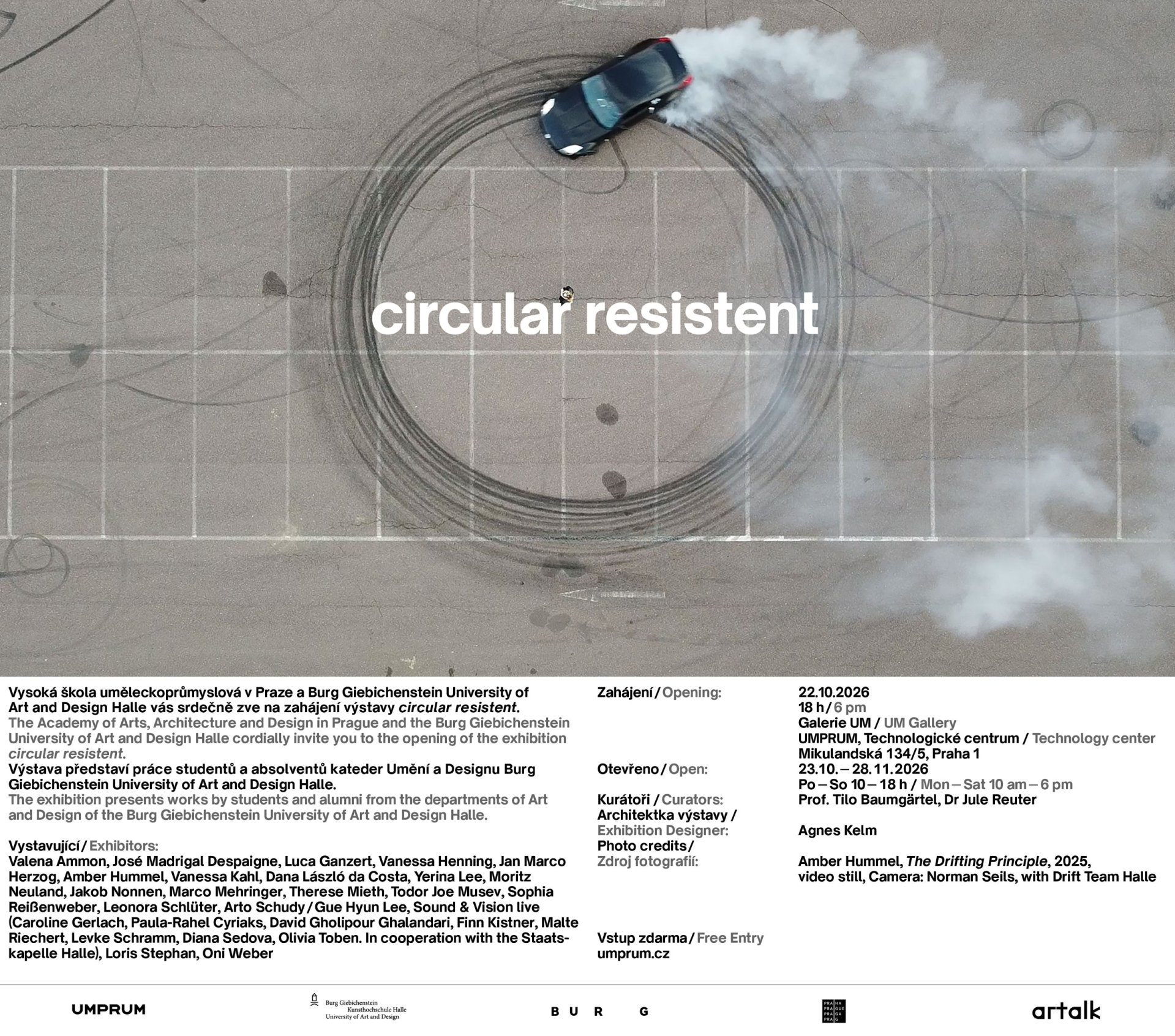
With her work Das driftene Prinzip (The Drifting Principle), the artist proposes a different understanding of neighbourhood. In the social theory she has developed, every person is response-able for their immediate surroundings. This imagined microsphere covers a diameter of ten meters, with oneself at its centre. A video makes this vision of society tangible in a striking way: the artist stands on an asphalted square and is filmed by a drone hovering above her. She marks the centre of her sphere of influence, which is delimited by a car drifting rapidly around her. As the tire marks build up with every lap, the circle surrounding her becomes visible and finally remains in the space as a precise drawing. In the voice-over, Amber Hummel speaks about how action begins with perception. What happens if neighbourhood is everything that lies within this ten-meter circle - and becomes the small power that every human being holds?
Dana László da Costa – Majestade & Vereda Roja
The artist Dana László da Costa grew up in the neotropical zone of rural Brazil. Living away from electricity, she developed a particular understanding of nature, which is reflected in her work. For her textile pieces she follows an elaborate creative process that begins with the search for barks and plants from her homeland. This synthesis of such different colours, derived entirely from the flora of the American continent, also stands metaphorically for the continent’s colourful and cultural diversity. The theme of the cultural memory of her homeland serves as the formative foundation for her works, which embody and defend nature and call for protection and foresight. The exhibited textile works in wool and in silk are a new cartographic arrangement of the diverse biomes of the American continent.
Marco Mehringer – Mining Noise
Ever shorter product life cycles and materials that are difficult to separate mean that millions of tons of electronics are discarded every year, losing many functional components and critical raw materials in the process. Mining Noise understands electronic waste as a resource and examines the potential of recycling at component level. Using a modular synthesiser as an example, an alternative concept of use emerges that redeploys components from discarded devices. The sound generator serves not only as a musical instrument, but also as an object of communication - for reuse and for responsibility in how we handle electronics. The open platform “Loopstation” documents how devices are dismantled and components integrated into new systems. In doing so, it creates emotional value in an economically worthless context, with the aim of testing new dynamics of exchange beyond conventional deposit-return systems.
Sophia Reißenweber – Break-up Lab
The Break-up Lab is devoted to the end of an emotional relationship: the one between a textile and its previous owners. In cooperation with research institutes and textile-recycling stakeholders, sustainable recycling processes are being developed for used textiles containing polyester fibers. With the help of the enzyme PHL7, fibres made of PET can be broken down within minutes in a biotechnological process. The recovered basic building blocks of the polymer are then metabolized by bacteria into a biodegradable plastic (PHA). Yarns and add-ons made of PHA facilitate the separation of contaminants and enable fibre-to-fibre recycling processes. Two circular garments demonstrate the aesthetic and functional potential and convey how biotechnological processes could close regional material loops for used textiles in the future. In addition, the Break-up Lab creates a transparent infrastructure for the collection of used textiles.
Oni Weber – Schlafwandler (Sleepwalker)
A giant feather down jacket, set upright, invites viewers to come into its care. With arms held out in front, as is typical of sleepwalkers, its empty sleeves reach into the space to ward off whatever comes towards it. In contrast to the jacket’s brown-printed outer skin, which symbolizes the flood of information, a white neutrality awaits us inside, in which a snail embroidered into the fabric lies hidden. The snail as a symbol of slowness, in close absorption with itself. One of the snail’s tactics for protecting itself from being overwhelmed is to turn its eyes inwards until it feels able once again to take stock of what lies before it. In the same way, viewers can step into Oni Weber’s sculptural jacket until they find the moment right to come out again.
Burg Giebichenstein University of Art and Design Halle
Founded in 1915, the Burg Giebichenstein University of Art and Design Halle has an incomparable profile in Germany, with excellent educational and study conditions in its art and design faculties. With over 1,100 students, it is one of the largest art universities in the country. Visionary thinking and design are promoted in more than 20 fields of study, as is the development of professional vocational skills. The university has well-equipped studios and workshops, and a network linking it to numerous research institutions, associations and companies. In the more than 100 years of its existence, the BURG has developed into an art academy that explores the dynamic relationship between practice and research. Thinking and working in a cross-disciplinary way is encouraged from the very beginning through its foundation course. The BURG also has the right to award doctoral degrees in Design and Art Sciences. The art university cooperates with partner schools in 25 European countries and a large number of universities outside Europe. The BURG is a partner of the Cumulus network of international art and design colleges and is part of the European association ELIA.