4 June – 9 June 2026
UMPRUM, Kasárna Karlín, Křižíkova 20/12, Prague 8, 1st floor
UMPRUM Technology Centre, Mikulandská 134/5, Prague 1
open daily 10 a.m.–6 p.m.
Opening: 3 June 2026, 6:00–10:00 pm, UMPRUM Technology Center, Mikulandská 134/5, Prague 1
Afterparty: 3 June 2026, from 10:00 pm, Bike Jesus, Štvanice Island 1125, Prague 7
What did UMPRUM students focus on over the past semester? Which themes resonated across studios, and how did young artists interpret them? The exhibition of semester and final studio works from the Academy of Arts, Architecture and Design in Prague (UMPRUM), ARTSEMESTR Summer 2026, explores these questions. This extensive, school-wide presentation will take place not only at the UMPRUM Technology Center, but primarily at Kasárna Karlín, where the school has temporarily relocated during the reconstruction of its main building. The new environment has become embedded not only in the everyday functioning of the school, but also in the very nature of the students’ creative output.
"UMPRUM’s temporary relocation to Kasárna Karlín is far less uncomfortable than I had expected. I believe our students feel similarly about the move. Kasárna has what is often referred to as a genius loci. A key role is played by the distribution of studios and classrooms on a single floor, which makes it easier to meet. This benefits the school’s community life as well as relationships between students and individual studios,” says UMPRUM rector Prof. Jindřich Vybíral, reflecting on the temporary change of address.
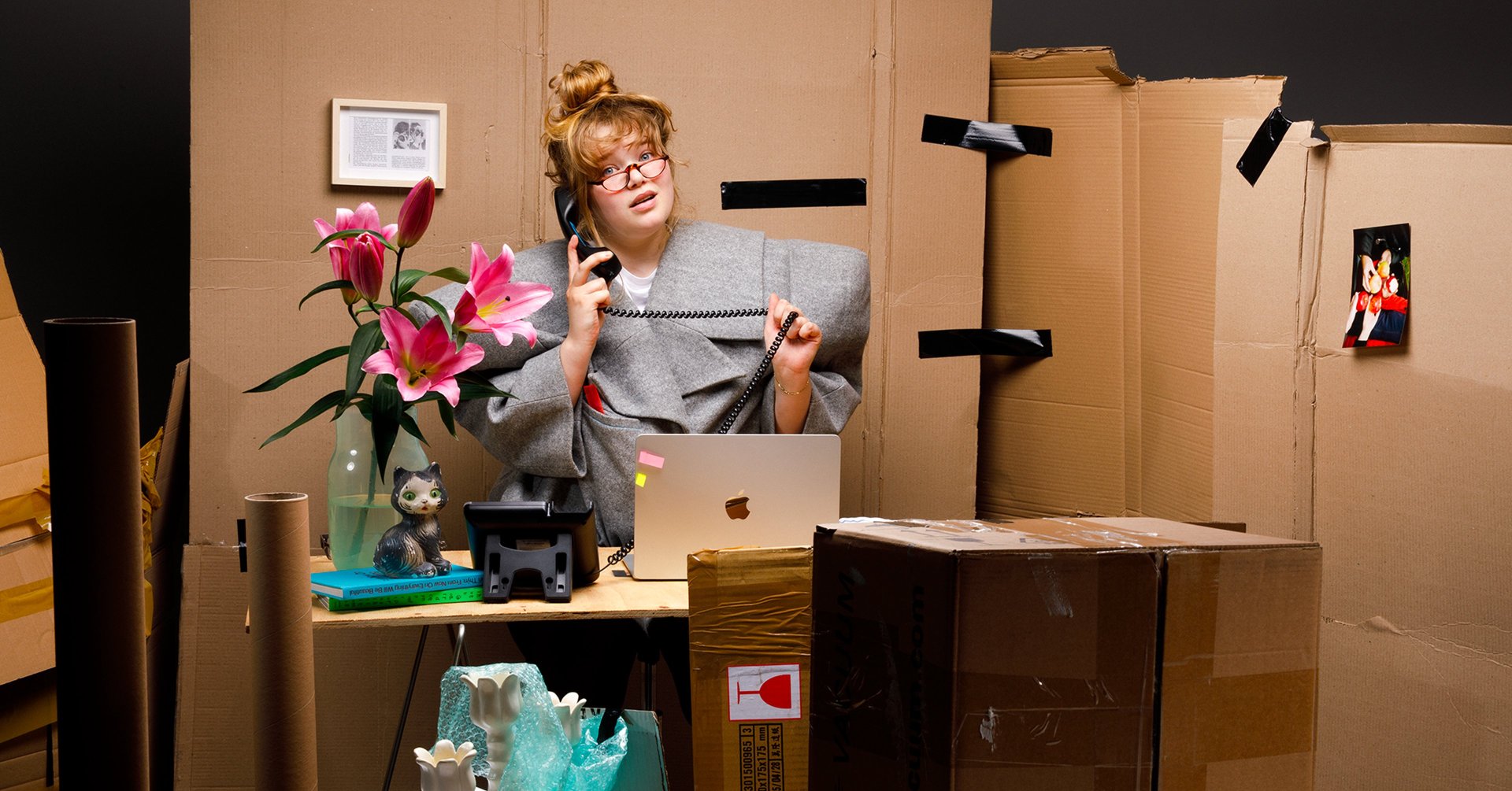
The exhibition’s visual identity also responds to the move with a sense of irony. It was created by photographers Hana Kubrichtová and David Stejskal in collaboration with graphic designer Karolína Kubišová. It depicts an exchange between fictional secretaries—one based in the established Technology Center in Mikulandská Street, the other in Karlín, where the relocation is still underway.
The new space at Kasárna Karlín has also been reflected in the briefs of several semester projects. Many studios adapted the former barracks spaces to better serve their function as exhibition venues. The Studio of Architecture I focused on how UMPRUM’s relocation to Karlín will influence the neighbourhood—and vice versa. Its vision of Karlín’s future will be presented in September at the Tallinn Architecture Biennale. The Studio of Fine Arts I, meanwhile, engages with Kasárna and Karlín through the theme of “survival and subsistence.
The exhibition will again feature collaborative, cross-studio projects. The Studio of Textiles, long focused on material research and the possibilities of textile production, has this time turned its attention to hemp and its applications. The process was continuously documented by the Studio of Photography II. The Studio of Product Design concentrated on a contemporary designer’s perspectives on the standalone door handle and ornament, developed in collaboration with artists working in fine art practice. The project is now being further developed together with students from the new Art and Design Management program and is being prepared for presentation at Brussels Design September in Belgium.
The newly launched Conservation and Restoration of Artistic and Craft Objects programme will also make its debut at ARTSEMESTR. It will present to the public the results of conservation and restoration work on specific objects, as well as technological replicas of historical artefacts.
Held twice a year, the school-wide ARTSEMESTR exhibition presents a broad range of themes, projects, and material approaches. It reflects the ongoing development of UMPRUM, showing how its students think, work, and gradually refine both their disciplines and their individual practices. This time, visitors will not only encounter the results of their work, but also see how the school has adapted to its new home in Kasárna Karlín over the course of several months—and how the space, in turn, has shaped the school itself.
ARTSEMESTR Summer 2026 will be open to visitors at both Kasárna Karlín and the UMPRUM Technology Center until the 9th of June 2026.
Studios and themes
Studio of Architecture I / Andrew Kiel, as. Jakub Herza, as. Viktória Mravčáková: accessibility and convivial tools of urbanism and infrastructure; visions for Karlín (various themes and sections) and collaboration with the Tallinn Architecture Biennale
Studio of Architecture II / A2 Future Architectures Platform / Eva Franch i Gilabert, as. Alžběta P. Brůhová, as. Kateřina Vídenová: Wild Planetary Systems: Design for Protected Areas in Transition — the studio theme builds on the global 30×30 commitment to protect 30% of the Earth’s land and oceans by 2030. It asks what protection actually means and whom it serves. In the context of rapid ecological change, the studio explores architecture as a regenerative tool that studies conflict, supports stewardship and care for territory, and creates new relationships between human and more-than-human actors. // Final project: Garden of Earthly Delights: New Multispecies Environments for Urban Habitats — a spatial, material, and ecological 1:1-scale installation expanding the semester’s research. The studio will transform into a shared interior landscape. Each project presents a situated cosmology — a way of organizing relationships between humans, plants, animals, soil, water, climate, maintenance, decay, governance, and time here in Karlín.
Studio of Architecture III / / Imrich Vaško, as. Shota Tsikoliya: Terra Botanica — loosely continuing the previous semester’s focus on the river and work with its surrounding territory, the studio explores architecture and its relationship to plants — architecture with plants and for plants. The project investigates the relationship between architecture and vegetation as a spatial, structural, and environmental question.
Studio of Architecture IV / Roman Brychta, as. Markéta Mráčková, as. Barbora Šimonová: Geology of Architecture II — focusing on the reuse of excavated material from the construction of Metro Line D. The studio develops housing proposals, sustainability strategies, and structural approaches, building on urban designs from the previous semester and selecting suitable sites for new urban housing that respects its context while integrating this unused material. The designs explore the incorporation of waste soil either as a standalone material or in combination with others. Structural components are tested through models at scales from 1:1 to 1:10. // Final project: construction of residential housing in the areas of new Metro Line D stations — model studies of structural elements made from rammed waste earth or other renewable and ecological building materials. The exhibition presents construction models including formwork systems and the full fabrication process.
Studio of Industrial Design / Ivan Dlabač, as. Vlastimil Bartas: First-year students’ sculptures and clay works expressing two strong opposing emotions; second-year students: mechanical principle — mechanical objects demonstrating a “simple” mechanical principle; 3rd- and 5th-year students in collaboration with external tutor Tomáš Chludil on the theme of “camping.” // Final project: clothespin
Studio of Furniture and Interior Design / Roman Vrtiška, Vladimír Žák, as. Petr Hák: Collaboration with LD Seating — a new product designed to organically complement their existing product range; interior modifications for the Karlín Theatre – Theatro Music Club — an architectural study focused on the new use of the space while preserving its original layout. The design should reflect a new approach to the space while also serving as inspiration for future real-world interventions. // Final project: LD Seating – prototype — production of a fully functional 1:1 prototype in collaboration with LD Seating.
Studio of Product Design / Michal Froněk, Jan Němeček, as. Michal Malášek: A contemporary designer’s perspective on the standalone door handle and ornament, using a specific production technology, in collaboration with a fine artist. // Final project: Ongoing collaboration between designer and fine artist — a pedestal for the presentation of a selected artefact.
Studio of Fine Arts I / Amálie Bulandrová, Kateřina Konvalinová, Dominik Lang: The theme of “survival” and “subsistence,” particularly in relation to UMPRUM’s new building in Kasárna Karlín. The studio explores so-called survival strategies — both “soft” and “hard” tools — developed in relation to (1) the materials of sculptural practice, (2) the institutions that determine our trajectories, and (3) the Karlín district. // Final project: Individual assignment. Definition of a personal topic, development of sketches and material studies, and realization of an artwork.
Studio of Fine Arts II / / Lenka Vítková, as. Denisa Bytelová, as. Helena Todorová: open theme
Studio of Fine Arts III / / Žil Vostalová, as. Lucie Rosenfeldová: Doppelgänger // Final project: open assignment
Studio of Fine Arts IV / Jiří Thýn, as. Václav Kopecký: // final project: Contemporary Art Practicum II
Visiting Artist Studio / / Sláva Sobotovičová, Harun Morrison (visiting artist): Symbiotic Inhabitation, Embedding and Grafting // final project: open assignment
Studio of Glass / Rony Plesl, as. Klára Horáčková: BEHIND THE SCENES — a project culminating in a presentation at Milan Design Week 2027. Preparation of an installation inspired by the opera La gazza ladra (The Thieving Magpie) by Italian composer Gioachino Rossini. The project explores the brilliance and reflectivity of glass as a formal quality, alongside themes of manipulation and false accusation, which are central to the opera’s narrative and remain strongly resonant today.
Studio of Ceramics and Porcelain / Milan Pekař, Tereza Sluková: Map and Landscape — focusing on the ways in which landscape can bear witness to human presence on the one hand, and how it, in turn, inscribes itself into our behaviour on the other. The map is not understood in the sense of literal cartography, but as a means of articulating and sharing these processes.
Studio of Concept – Object – Meaning (K.O.V.) / Tadeáš Podracký, as. Kateřina Jirsová: Technological assignments — a set of hammered vessels, a water-carrying vessel, and a ring for a selected individual. // Final projects: Habit as Material — habit as bodily practice and material for design research. The work engages with everyday automatisms and repeated gestures that shape the relationship between body, environment, and social norms. The resulting objects respond to specific bodily habits of another person. The object here does not function as a corrective tool, but as a mediator that disrupts automatism, slows down action, and opens space for awareness, reflection, and new bodily experience.
Studio of Fashion Design / Miroslav Sabo, as. Tereza Rozálie Kladošová: A collection inspired by randomly assigned films. Students were required to process the film conceptually and translate it into a design series, also using AI tools. AI functions as a tool for creativity, supporting idea development or replacing costly photography and video production. The technical focus is the trench coat — its history, construction, and detailing. // Final project: a model inspired by the film and an AI-generated video featuring the model placed in an environment related to the film.
Studio of Fashion and Footwear Design / Simona Rybáková, as. Vojtěch Novotný, as. Michaela Vrátníková: Head to Toe — building on the previous semester’s project Head: Artpiece – Headpiece. The studio focuses on corporeality, silhouette, and volume, including material and structural solutions. The outcome is clothing collections or unique garments that are conceptually and formally linked to the previous project.
Studio of Textile Design / Linda Kaplanová, as. Martin Pondělíček: SEJ KONOPÍ — a focus on traditional textile fibers and the exploration of their further potential. The studio deepens the semester project “Fiber – Medicine – Symbol,” addressing themes of care, ecology, wellbeing, tradition, ritual, and critique across various forms between art and design. In collaboration with Farma Lapka and Tkalcovna Kubák, the work shifts towards a more industrial approach to fiber processing, for which students seek appropriate applications. In the final phase, the Textile Studio collaborated with the Studio of Photography II, whose students document the newly created works through their own artistic perspectives.
Studio of Illustration and Graphics / Juraj Horváth, as. Michaela Kukovičová: Maps — a project for the Bologna Children’s Book Fair. The map is explored as a game: a map of the Moon, a map of the smallest seed in the world, a map of mysterious finds, a dog map, and others. // Final project: Italian Holidays — echoes from the spring plein air in the Tuscan landscape, expressed through drawings, paintings, and diaries.
Studio of Type Design and Typography / Filip Kraus, Jan Čumlivski: a project based on the principle of the authorial document across the platforms of graphic design, typography, type design, editorial practice, and visual essay. // Final project: graphic design proposals for the visual identity of the NHK Collection Lidice exhibition organized by the Lidice Art Collection.
Studio of Graphic Design and Visual Communications / Zuzana Lednická, as. Richard Jaroš: Monte di Luce — the creation of a comprehensive sample book of offset printing possibilities for the Italian paper mill Cartiere del Garda, part of EUROPAPIER. // Final project: a screen-printed accompanying poster (for the comprehensive sample book of offset printing possibilities).
Studio of Animation and Film / Michaela Režová, Jan Drozda, as. Jakub Zich, as. Zuzana Bukovinská: Pastiche — focusing on the boundary between digital and analogue animation. The aim is to push the limits of established animation techniques, combine them in unexpected ways, and imitate their typical features and visual language through different techniques.
Studio of Graphic Design and New Media / Petr Babák, as. Lukáš Kijonka, as. Martin Ponec: Forming a band (or an independent music/sound project) — students develop their own musical projects alongside original audio material and sound recordings, as well as a complete visual identity and all related outputs, including posters, album covers, photography, music videos, merchandise, and other accompanying materials.
Studio of Photography II / Alena Kotzmannová, as. Karin Zadrick, as. Tomáš Zumr: Selected semester works on the theme “Analog” are presented in the exhibition Simple Things until 12 July at the Minorite Monastery, Malá Štupartská 635, Prague 1, entrance area of the cloister. // Final project: collaboration with the Textile Studio on the theme of hemp — photographic zines and projections of photographs connected to the Textile Studio’s theme.
Studio of Design and Digital Technologies / Jan Netušil, as. Jiří Hölzel: Alternative modes of representation — an exploration of the development of imaging technologies, a critical assessment of their limitations, future trajectories, and impact on everyday life. The studio focuses on mapping and discovering new or forgotten alternative imaging methods with both practical and artistic potential. During the semester, each student develops their own flip-display module, which is then connected with others into a single functional display system. // Final project: open project based on the semester theme.
Conservation and Restoration of Artistic and Craft Objects / Marie Foltýnová: restoration or conservation of a specific object within a chosen material specialization / technological replicas of historical objects of artistic craft.
Visual Arts, follow-up Master’s program taught in English / Hana Smělá, Conrad Eric Armstrong: A Little Partz Might Kill Someone — presentation of works exhibited at the A4 gallery in Bratislava.