The Academy of Arts, Architecture and Design in Prague (UMPRUM) organized a week-long Blended Intensive Programme (BIP) workshop in May 2025 as part of the Erasmus+ program. The aim of BIP is to support international collaboration between higher education institutions and to connect students and academic staff from different European countries. The program was targeted at doctoral students and focused on artistic, art-historical, and technological research, with a particular emphasis on innovative study methods, interdisciplinary research, and the use of new technologies, including the latest developments in artificial intelligence applications
For a week, UMPRUM hosted three partner universities: the Belgian École Nationale Supérieure des Arts Visuels de La Cambre, the Estonian Eesti Kunstiakadeemia, and the Slovak Vysoká škola výtvarných umení v Bratislave (VŠVU). The aim of the BIP was to provide its 26 doctoral students with opportunities for reflection, exchange of experiences, and comparison of methodological approaches in their research, while also enabling them to establish international contacts. A total of 14 students from partner institutions participated, alongside three academic staff members and other guests from outside the university environment. All participants had the opportunity to attend lectures as well as actively present their research projects, discuss them with colleagues and experts, and engage in workshops and other informal activities.
Program Schedule
The first official activity of the BIP was a virtual meeting held a month before the Prague workshop. During this activity, the participating institutions introduced themselves, followed by a presentation of the program and preparation of participants for its interactive blocks. During this phase, students familiarized themselves in detail with the topics of the individual sections, defined how their own research connected with other projects, and received assignments for independent preparation.
The main part of the project was the week-long workshop in Prague, where both Czech and international students participated in several thematic blocks focused on methods of artistic and technological inquiry, as well as the study of modern and contemporary art history and theory. Considerable attention was paid to environmental issues and sustainability, as well as to the topic of artificial intelligence. Participants worked on group projects involving creative workshops and discussions, focusing on comparing the research methods they use. The program also included visits to cultural institutions, such as the National Gallery in Prague, where participants discussed contemporary art in a broader theoretical context. The program also included a tour of modernist architectural landmarks in Prague.
As part of the official program, five workshops were prepared and led directly by the students. The goal of the BIP was to allow doctoral students not only to present their research but also to actively participate in the program by preparing and leading their own sessions. The workshops focused on research methods used by the students, which they shared with other participants. The presenters then challenged their audiences to support or contradict these methods by presenting their own examples of similar case studies. This interactive form of teaching allowed doctoral students not only to impart their expertise, but also to receive feedback and enrich their research with new perspectives from colleagues at other universities.
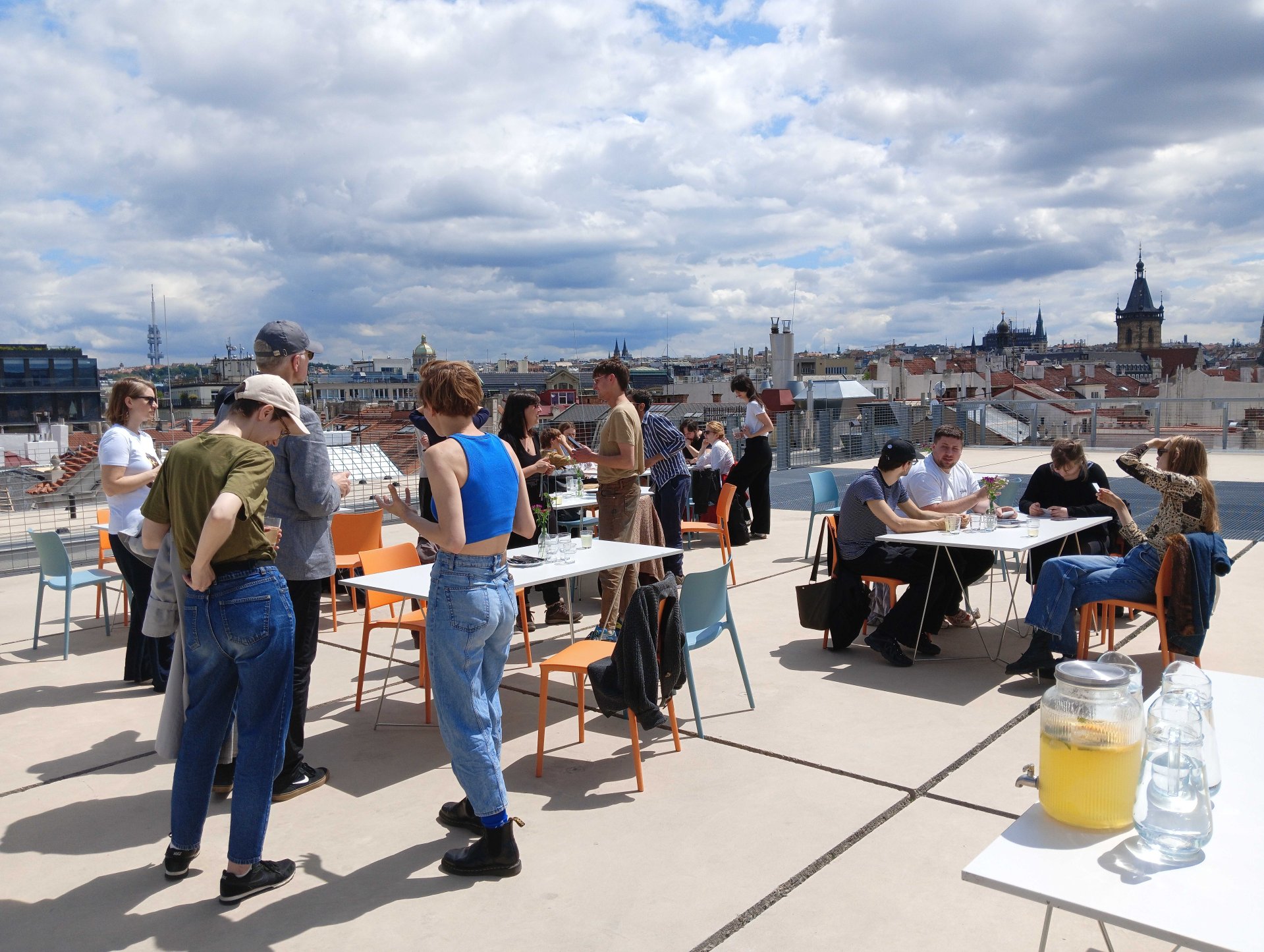
Most of the program took place in the UMPRUM Technological Center, which is equipped with modern equipment and allows students to present their projects interactively and efficiently. Part of the program was also held in the external school spaces, specifically in Kafkárna – Centre for Art and Ecology UMPRUM, an informal location with a distinctive atmosphere that allowed students to discuss their work in a relaxed environment.
Lectures and Guest Speakers
A key part of the BIP were lectures from external guests. Andres Kurg from Eesti Kunstiakadeemia focused on the history of Soviet architecture and its exhibition in the West during the Cold War. Kurg specifically addressed the 1978 exhibition “L’Espace Urbain en URSS, 1917–1978” at the Centre Pompidou in Paris. This exhibition, with its accompanying catalog, sought to present Soviet architecture to a French audience from the perspective of competing geopolitical blocs divided by the Iron Curtain, and within the framework of a colonial discourse highlighted remarkable projects from various Soviet countries (e.g., Estonia, Ukraine, Armenia) as the “Soviet” contribution to post-war experimental architecture. Kurg focused, among other things, on the controversies that the exhibition provoked and examined how to consider and write about architecture produced during the Cold War, reflecting on issues of cultural appropriation and identity without applying established political shortcuts.
The second guest lecture was delivered by Czech artist Eva Koťátková, who presented in detail her artistic research on the life of Lenka the giraffe, which was transferred to the Prague zoological garden in the 1950s. The questions posed by the artist concerned human relationships with (animal) bodies, empathy, and environmental issues. Koťátková also described how her research culminated in the exhibition The Heart of a Giraffe in Captivity is Twelve Kilos Lighter, which the Czech Republic presented at the Venice Biennale in 2024, with a reprise taking place at the Veletržní Palace of the National Gallery Prague during the duration of the BIP.
The final lecture was delivered by Peter Salaba in collaboration with UMPRUM's student Jan Netušil. Salaba demonstrated practical applications of generative tools in film and broadly illustrated the influence of this technology on cultural production. Jan Netušil then explained to students in real time how are generative tools used, enabling participants to better understand technological possibilities in the fields of art, film, and product design.
Program Outcomes
The Blended Intensive Programme allowed doctoral students not only to share their research methods but also to create joint outputs. In addition to individual student presentations within the workshops, short videos were produced focusing on non-verbal ways of expressing emotions, as well as an interactive mood board exploring concentrated perception of space through one’s own body.
Participants also gained new professional contacts and developed skills in presentation, international collaboration, and communication. The program contributed to the development of their digital competencies and understanding of both the possibilities and limitations of working with artificial intelligence. At the same time, participants were given space for critical thinking through discussions. In future editions, we plan to dedicate part of the program to networking activities, allowing students to discuss their projects in greater detail, in smaller groups, and in a more informal setting.