Workshop se Sarah Dubnou
(nový termín)
13. 4. 2026 10AM-2pm
Kafkárna, Buštěhradská 2, Praha 6
Přihlašujte se prosím závazně přes formulář:
https://docs.google.com/forms/d/e/1FAIpQLSdDaO9G733Al_ZfBmL07a8aPUw8GxMSHbd30Ym0JkVD5GfRMQ/viewform?usp=dialog
Workshop se Sarah Dubnou
(nový termín)
13. 4. 2026 10AM-2pm
Kafkárna, Buštěhradská 2, Praha 6
Přihlašujte se prosím závazně přes formulář:
https://docs.google.com/forms/d/e/1FAIpQLSdDaO9G733Al_ZfBmL07a8aPUw8GxMSHbd30Ym0JkVD5GfRMQ/viewform?usp=dialog
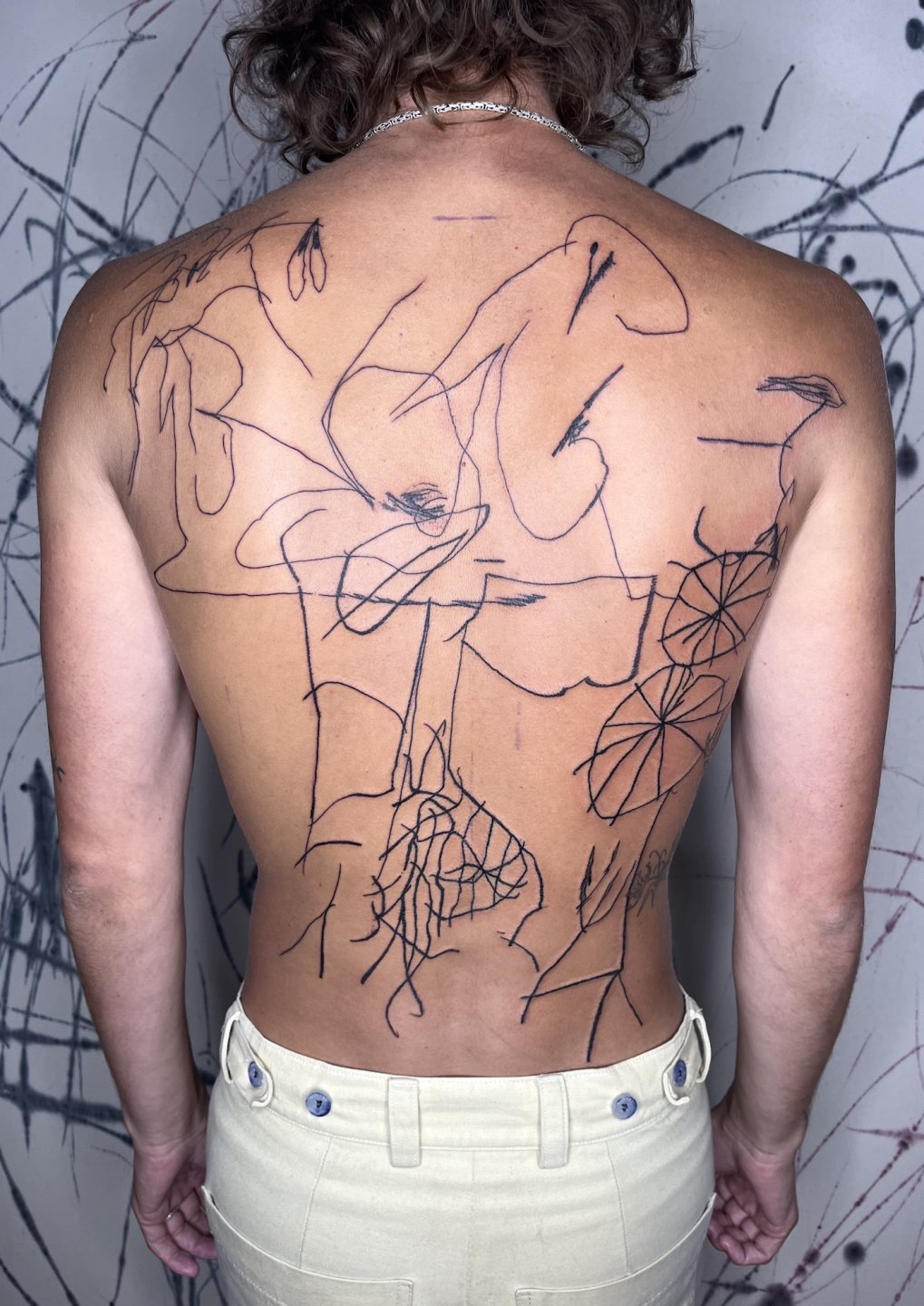
What if wounding is not destruction but method—and what if loss is often a condition of transformation? This paper theorises stinging/scratching as a practice-led queer method through which relation is made and embodied knowledge is produced. I use stinging and scratching as two registers of the same method: stinging centres puncture, pain, trust, and aftercare; scratching names a reclaimed DIY lineage of consent-accountable technique. I use both across skin, wall, and textile as context demands. My practice is translocal: sustained by guest spots and hosting exchanges in queer-friendly studios worldwide, where travel, shared accommodation, and mutual aid form an infrastructure of care operating both within supportive institutions and across peer networks.
I set the stakes through a concise comparison with canonical examples. Rachel Whiteread’s casting—where outer structures are demolished for interiors to appear—and Doris Salcedo’s Shibboleth—a monumental institutional crack—exemplify unilateral exposure: a one-directional cut aimed at revelation rather than relation, where consent/aftercare are not structurally central. In dialogue with Jack Halberstam’s writing on un/building (alongside Matta-Clark’s surgical openings), I place these beside situated, reciprocal wounding in my practice: I tear/suture found canvases and textiles and mark institutional walls and human skin with related lines and motifs (e.g., I’m Sick of Fucking and Not Knowing How to Rage, Galerie Jelení, 2024). The same drawing can live in the gallery and on a person’s body—for a time, wall and skin are treated as equivalent surfaces, briefly connecting these worlds. For me, the institution is a platform to make this care visible, to carry shared social problems into public space, and to help institutionalise the topic without displacing the people who live with it.
The paper advances a protocol-centred account with emphasis on translocal economies of care. In my sessions, consent is treated as a process, not a one-time signature—typically including pre-tattoo conversations about pain expectations and stoppage rights, clear refusal options, rigorous hygiene and harm-reduction, and shared aftercare (healing check-ins, documentation). Across the guest-spot networks I work within, these practices appear in varied, sometimes informal ways—less as standardised forms than as an ethic many practitioners aim toward. Resources such as Tamara Santibañez’s Could This Be Magic? Tattooing as Liberation Work help articulate this orientation, but uptake is uneven by context, which is why specifying teachable, portable procedures matters.
Conceptually, I use “cultivating the wound” to describe a practice-led method: to open, tend, and keep open a passage for relation and accountability. I do not aim to moralise the cut; I hope to show, cautiously, what a consensual, accountable incision can enable in concrete procedures and politics—whether in studios, galleries, or in the border-crossing spaces where queer tattooing often unfolds. Rather than relying on distant theories or presuming uniform standards, I build from existing practice—care that already happens, sometimes quietly—and I propose modest ways it can be named, taught, and adapted.
Bio:
Sarah Dubná (b. 1993) is a visual artist and tattoo practitioner based in Prague. Her work probes what lies beneath surfaces—paper, walls, found textiles, and human skin—using gestures of poking, scratching, and perforation to test the line between destruction and healing. She moves between visual art, beekeeping, and tattoo communities, bringing these worlds into dialogue in exhibitions in Czechia and Berlin and in publications such as PokePokePoke (2020, 2022). She is currently a PhD candidate at UMPRUM, developing the practice-led project Stinging as a Radical Mode of Storytelling, focused on consent-accountable incision across skin, wall, and textile and on translocal guest-spot networks as infrastructures of care.